
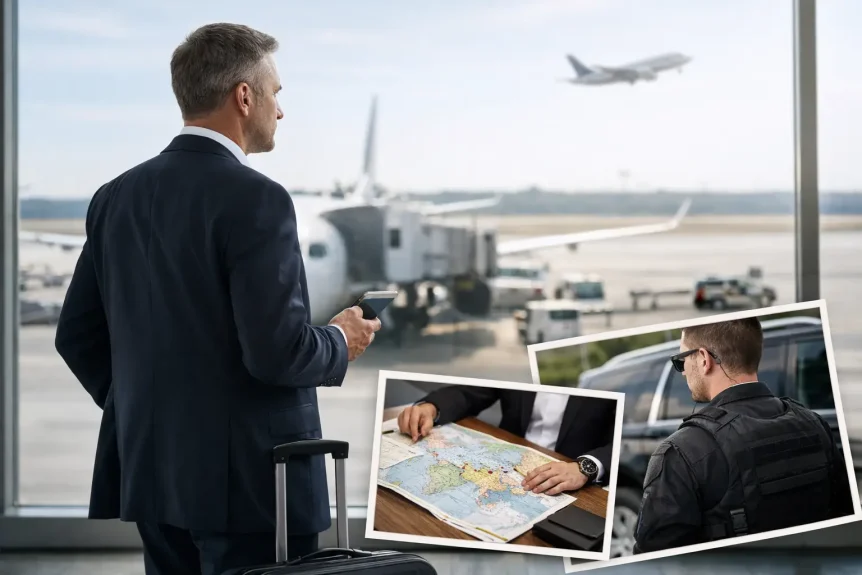
A delayed flight, an unplanned venue change or a public appearance can alter an executive’s risk profile in minutes. For senior leaders, high-profile individuals and travelling teams, executive travel risk management is not about adding visible security to every itinerary. It is about maintaining control over people, information, movement and decision-making when normal operating conditions are no longer guaranteed.
The most effective arrangements are proportionate, discreet and built well before departure. They protect the principal without turning a commercial trip, investor meeting, site visit or private engagement into a security spectacle.
Executive travel risk management begins before departure
Travel risk is rarely confined to a destination. Exposure often begins when an itinerary is shared, a booking is made under a recognisable name, or a meeting location becomes known outside the immediate team. The risk may be physical, reputational, digital or operational. Frequently, it is a combination of all four.
A disciplined pre-travel assessment establishes what genuinely requires protection. This includes the traveller’s public profile, the purpose of travel, destinations and transit points, accommodation, meeting venues, local conditions, transport arrangements, online exposure and known or emerging threats. It should also consider whether the executive will be carrying sensitive information, making commercially significant decisions or attending a high-visibility event.
The outcome should not be a generic travel checklist. It should be a clear operating picture: where exposure exists, what controls are appropriate, who holds decision-making authority and how the team will respond if circumstances change.
For a chief executive travelling quietly between Auckland and Wellington, the appropriate measure may be secure transport coordination, confidentiality controls and a reliable escalation process. For a visiting public figure, a senior executive involved in a sensitive transaction, or a team travelling into a volatile environment, the plan may require protective personnel, advance work, venue liaison and active intelligence monitoring. The level of support depends on the risk, not the title alone.
The risks that standard travel policies miss
Corporate travel policies are useful for booking, expense management and basic welfare. They do not always address targeted risk. A policy may confirm that a traveller has accommodation and emergency contacts, yet say little about who has access to their schedule, whether the hotel arrival is exposed, or how a confrontation outside a meeting venue will be managed.
Executive travel requires a closer examination of the points at which routine arrangements become predictable. These commonly include publicly advertised appearances, repeated travel patterns, social media posts, hotel lobbies, airport transfer areas and informal dinners where security is assumed rather than managed.
Several conditions deserve particular attention:
- A credible threat, unwanted contact, stalking concern or contentious business matter.
- High public visibility, including media attention, celebrity status or a prominent leadership role.
- Travel linked to restructuring, disputes, negotiations, investigations or other sensitive activity.
- A destination affected by civil disruption, elevated crime, severe weather, infrastructure failure or limited emergency services.
- A travel party that includes family members, junior staff or overseas visitors unfamiliar with local conditions.
None of these factors automatically calls for close protection. Over-protection can create its own problems, drawing attention and disrupting the purpose of the trip. Under-protection is equally costly when an incident compromises safety, privacy or business continuity. Sophisticated handling means selecting controls that are credible, effective and appropriate to the individual and environment.
Intelligence turns assumptions into decisions
Good executive travel risk management relies on current information, not outdated country ratings or assumptions based on previous visits. Conditions can change quickly. A location regarded as low risk may have a nearby protest, industrial action, a transport interruption or an event that substantially alters access and crowd behaviour.
Pre-travel intelligence should test the itinerary against real conditions. This may involve reviewing local threat activity, identifying secure arrival and departure options, assessing venues, confirming medical and emergency capability, and considering who may be aware of the executive’s movements. For sensitive assignments, discreet enquiries can also establish whether a concern is credible, opportunistic or unsupported.
Intelligence must lead to action. If a meeting venue has limited controlled access, the answer may be to amend the venue or arrival procedure. If a major event will affect traffic and crowd density, the transport plan and timing must change. If a threat is assessed as elevated, the protective posture should be adjusted before the principal is exposed.
This is where experienced security and investigation capability adds value. It separates material risk from noise, allowing executives to travel with confidence rather than being burdened by unnecessary restrictions.
Build an itinerary that can absorb disruption
An itinerary is not merely a sequence of bookings. It is the operational framework for the entire movement. It needs enough detail to support protective planning, but distribution must remain tightly controlled. Wider circulation creates unnecessary exposure, particularly where travel involves high-profile people, sensitive commercial matters or multiple external suppliers.
Every critical movement should have a primary plan and a practical alternative. That includes airport transfers, accommodation access, meeting arrival points, venue exits and onward travel. Contingency does not require complicated procedures for every possibility. It requires agreed options that can be implemented quickly when a flight is cancelled, a route is blocked or a venue becomes unsuitable.
Transport deserves particular care. The correct vehicle, a suitably briefed driver and a clear pickup protocol remove common points of uncertainty. For higher-risk movements, protective personnel may conduct advance checks, coordinate secure loading and departures, and maintain situational awareness throughout the journey. The principal should not be left trying to identify a vehicle, negotiate an unfamiliar pickup area or make security decisions under pressure.
Accommodation must also be assessed as part of the wider route, not in isolation. Consider access points, surrounding activity, parking, room allocation, visitor controls and how the executive will move between the vehicle and the property. Privacy is often preserved through quiet coordination rather than highly visible measures.
Protective personnel should enable business, not interrupt it
Personal protection is most effective when it supports the executive’s objectives. The role is not to dominate meetings, restrict normal interaction or create an intimidating presence. It is to provide calm judgement, advance awareness and immediate capability should a situation deteriorate.
Elite personnel understand that executive care requires discretion. They can coordinate logistics, manage arrivals and departures, identify developing concerns and preserve a respectful environment for clients, staff and stakeholders. Their presence should fit the setting, whether that is a boardroom, conference venue, construction site, private residence or public event.
Professional selection matters. Personnel with military, intelligence and law-enforcement backgrounds can bring sound judgement, communication discipline and an understanding of escalation thresholds. However, background alone is not enough. The individual must be properly licensed, appropriately trained, briefed on the assignment and capable of representing the client with absolute professionalism.
For New Zealand clients, working with a government-licensed provider under the Private Security Personnel and Private Investigators Act framework is a fundamental safeguard. It demonstrates that protective work is being delivered within the appropriate professional and regulatory standards.
Keep communications controlled and escalation clear
Travel plans can fail through poor communications as readily as through physical disruption. The travelling executive, executive assistant, protective team, driver, organisational security lead and key decision-makers must know what information they need, when they need it and who is authorised to change the plan.
There should be a simple reporting structure for incidents and near misses. A concerning approach at a hotel, a suspicious enquiry about an itinerary or a transport irregularity may not require an immediate operational response, but it should be recorded, assessed and communicated to the right person. Small indicators can reveal a pattern when viewed together.
Privacy must be protected throughout. Itineraries, hotel details, vehicle registrations and protective arrangements should be shared on a need-to-know basis. This applies equally to internal teams, contractors and event partners. Convenience is not a reason to distribute sensitive movement information widely.
Review each journey and strengthen the next one
The completion of travel should trigger a short, factual review. Were routes and timings effective? Did suppliers perform as expected? Did the protective posture suit the actual conditions? Were there security observations that require follow-up, investigation or a change to future arrangements?
This review is especially valuable for executives who travel regularly or visit the same locations. Patterns become visible over time, and practical adjustments can improve both safety and efficiency. The aim is not to make every trip more restrictive. It is to make future travel better informed and more controlled.
TNG Security applies this disciplined approach across executive care, personal protection, intelligence and operational planning. For organisations and private clients, the right support is not simply a guard at the door. It is a trusted protective partner that anticipates exposure, manages disruption with precision and safeguards what matters without compromising the journey itself.
When the itinerary carries commercial consequence, public attention or personal exposure, treat travel planning as a protective operation from the outset. The right preparation gives leaders the freedom to focus on the reason they are travelling, while capable professionals manage the risk around them.