
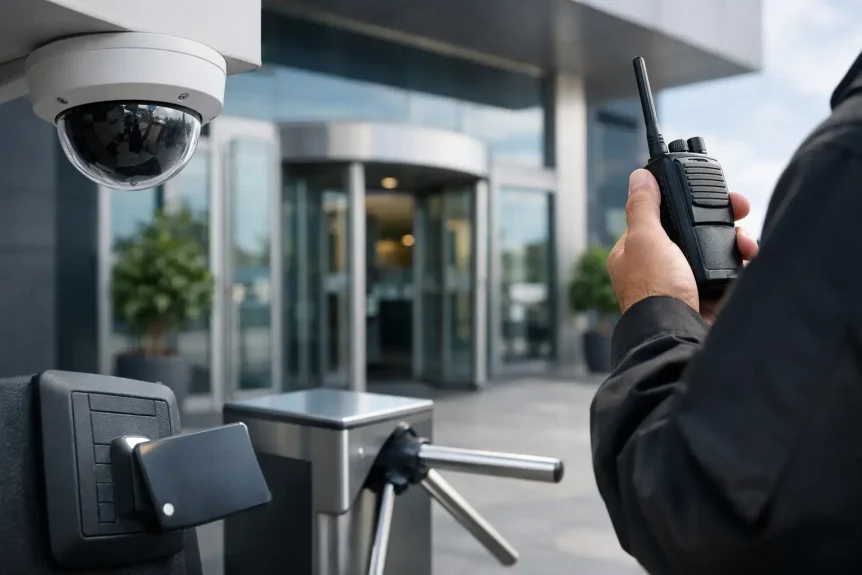
A forced door at 2 am is obvious. A contractor using an unescorted access card, a staff member propping open a rear entrance, or stock leaving through a loading dock can be far more difficult to detect – and more damaging over time. Knowing how to protect commercial premises means looking beyond alarms and cameras to understand how people, assets, routines and information are exposed during normal operations.
For New Zealand businesses, commercial security is not a single product or a once-a-year compliance exercise. It is an operating discipline. The strongest arrangements combine visible deterrence, controlled access, trained personnel, clear reporting and a response plan that remains effective when an incident is stressful, inconvenient or reputationally sensitive.
How to protect commercial premises with a layered approach
Every site has a different risk profile. An Auckland office handling sensitive client data faces different pressures from a Christchurch construction site, a Wellington government-adjacent workplace, a retail tenancy or a logistics facility with high-value stock. The common mistake is applying the same security package to each of them.
Begin with a site-specific risk assessment. This should examine the premises at different times of day, not only during business hours. Consider public-facing areas, staff-only zones, car parks, loading bays, roof access, plant rooms, perimeter fencing, adjacent properties and the routes people use to enter and leave.
The assessment should also identify what needs protection. That may include physical assets, controlled products, cash, intellectual property, staff safety, confidential conversations, executive movements or continuity of operations. Once priorities are clear, security measures can be matched to the consequence of loss rather than selected on price alone.
A layered model accepts that no single control is perfect. Physical barriers delay unauthorised entry. Access systems restrict movement. surveillance improves visibility. Security personnel intervene, verify and report. Procedures ensure that the organisation responds consistently. If one layer fails, another should still reduce the opportunity for harm.
Start at the perimeter, not the reception desk
A site’s perimeter sets the first condition for security. Poor lighting, damaged fencing, unsecured gates, obscured sightlines and uncontrolled vehicle access invite opportunistic offending and make suspicious activity easier to conceal.
Lighting should support observation rather than simply illuminate a building. Entrances, pedestrian routes, car parks, loading areas and storage yards require appropriate coverage, with regular checks for failed fittings and shadows created by vegetation or parked vehicles. CCTV placement should be driven by likely movement routes and asset locations, not by where cameras are easiest to install.
Physical security also needs to suit the environment. A high-security office may require controlled entry points, reinforced doors and secure visitor management. A construction or industrial site may need temporary fencing, after-hours patrols, plant protection and strict key control. Retail premises often need a balance between customer access, staff safety and visible loss prevention.
Too much friction can undermine operations. If staff routinely find access controls inconvenient, they will create workarounds. A secure design makes the approved process practical enough to follow every day.
Control the overlooked entry points
Rear doors, fire exits, delivery entrances, shared corridors and loading docks frequently receive less attention than the front entrance. They should not. Fire exits must remain compliant and available for emergency evacuation, but that does not mean they should become unmonitored access points.
Review who can open each door, when they can do so and how an exception is recorded. Door alarms, access logs, appropriate signage and patrol checks can provide accountability without obstructing legitimate movement. Where deliveries are frequent, establish a controlled handover area rather than allowing drivers or visitors to move freely through operational spaces.
Treat access control as a people process
Access cards, keys, codes and mobile credentials are only effective when their administration is disciplined. Former employees, departed contractors and temporary visitors should not retain access because someone forgot to update a register.
Assign ownership for issuing and cancelling credentials. Access should be based on role and necessity, with higher-risk areas limited to those who genuinely require entry. Review permissions after role changes, extended leave, contractor completion and staff departures. Lost cards and keys should trigger a documented response, not an informal assumption that they will turn up.
Visitor management deserves the same care. Require visitors to identify themselves, record their host and wear a visible pass where appropriate. For sensitive sites, hosts should meet visitors at reception and remain responsible for them while on site. This is not about making clients feel unwelcome. It is about ensuring the organisation knows who is present when an incident, evacuation or security concern occurs.
Use technology to create usable intelligence
Security technology is valuable when it produces reliable evidence and prompts action. Cameras that are poorly positioned, unmaintained or never reviewed can create a false sense of control. The same applies to alarms that repeatedly generate false activations and are eventually ignored.
Design CCTV coverage around clear operational questions: can the system identify a person entering a restricted area, verify activity at a loading dock, observe a cash-handling point, or support an investigation after an incident? Image quality, lighting conditions, recording retention and access to footage all matter. Privacy obligations must also be considered, particularly in workplaces and public-facing environments.
Alarm monitoring should be connected to a defined response process. Who receives the alert? Who can attend safely? When should Police be contacted? Who has authority to close the premises, preserve footage or notify senior management? Technology detects. People decide and act.
For larger or higher-risk sites, integrating access records, patrol observations, alarm events and incident reports can reveal patterns that isolated systems miss. Repeated after-hours access, unexplained stock discrepancies or recurring perimeter breaches may indicate a procedural weakness, criminal reconnaissance or an internal issue requiring discreet investigation.
Protect against internal and routine risks
Not every commercial loss begins with a break-in. Internal theft, fraud, careless handling of keys, unauthorised disclosure, workplace conflict and poor contractor oversight can all compromise a premises and its operations.
A professional security plan should include clear reporting channels for suspicious behaviour and security defects. Staff need to know what to report, who to contact and that raising a concern will be handled fairly and discreetly. Vague instructions such as “be vigilant” are not enough. Give teams practical indicators: an unfamiliar person tailgating through a secure door, repeated attempts to access areas outside a person’s role, unexplained photographs of equipment, or deliveries that do not match expected records.
Staff training should be proportionate. Reception teams may need conflict-management and visitor-verification skills. Warehouse staff may need procedures for seal checks, vehicle movements and stock handovers. Managers may need to understand escalation, evidence preservation and communications during a serious incident.
Build a response plan before it is needed
The quality of a security response is often decided before the incident occurs. A written plan should cover intrusion, threatening behaviour, theft, suspicious packages, medical emergencies, fire evacuation, protest activity and critical service disruptions where relevant to the site.
For each scenario, define four essentials:
- who has immediate authority to act;
- how staff contact security, emergency services and management;
- where people move to remain safe; and
- how incidents, evidence and communications are documented.
Test the plan through practical exercises. A tabletop discussion may expose uncertainty in decision-making, while a controlled site exercise can reveal whether access, communications and staff roles work as intended. Review incidents and near misses afterwards. The purpose is not to assign blame. It is to close gaps before they become costly.
When professional security support is warranted
Some sites can manage routine security through well-designed systems and trained internal staff. Others require a visible, accountable protective presence. The decision depends on the value and sensitivity of assets, operating hours, history of incidents, public exposure, workforce risks and the consequences of disruption.
Professional security personnel can provide gatehouse control, access management, patrols, concierge-style front-of-house coverage, alarm response, incident reporting and escalation. For sensitive matters, a provider with investigation and risk-management capability can assist in assessing threats, preserving facts and managing a response without unnecessary attention.
The standard of personnel matters. Commercial clients should seek a government-licensed provider that can demonstrate vetting, supervision, reporting discipline and clear operational leadership. TNG Security combines trained frontline personnel with security consulting, investigation and risk-management capability for organisations that require sophisticated handling rather than basic guarding alone.
The right security arrangement should feel controlled, not intrusive. It should protect staff, visitors, assets and reputation while allowing the business to operate with confidence. Review it whenever your premises, people, operating hours or risk exposure changes. Security is most effective when it evolves before a threat forces the issue.