
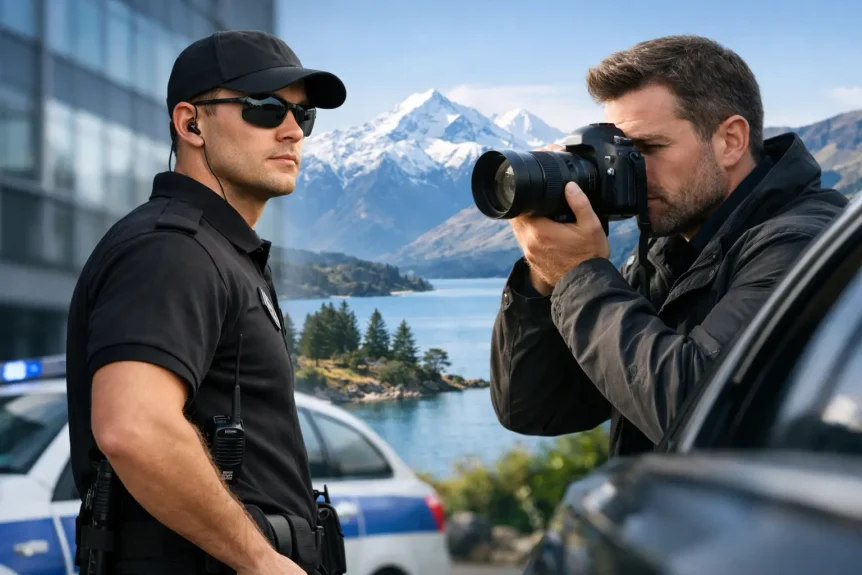
A uniform, a radio and a confident presence can create an impression of capability. They do not, on their own, prove that the person protecting your property, people or event is authorised to perform security work. Security guard licensing is the first point of control in a proper procurement process – particularly where disruption, theft, public safety, executive exposure or reputational risk are on the line.
For New Zealand clients, Government licensing by the PSPLA should be treated as a non-negotiable baseline, not a premium feature. It confirms that a provider and its personnel operate within the legal framework governing private security. The more demanding question is whether that licensed provider has the people, supervision, planning and judgement to manage the risk in front of you.
New Zealand Government (PSPLA) Security Guard and Private Investigator Licensing
Private security work in New Zealand is governed by the Private Security Personnel and Private Investigators Act 2010. The Private Security Personnel Licensing Authority, commonly known as the PSPLA, administers the licensing regime for relevant security and private investigation work.
In practical terms, a security business undertaking PSPLA licensable work needs the appropriate licence, while frontline personnel undertaking that work generally require an individual Certificate of Approval, or COA. These approvals are not interchangeable. A business licence does not remove the need for appropriately authorised staff, and an individual COA does not prove that the company deploying that person has sound operational systems.
The precise approval or licence required depends on the work being performed. Static security guarding, crowd control, event security, venue security, personal protection (bodyguarding), private investigations and other specialist functions can involve different categories and obligations. That distinction matters. A client engaging security for a corporate headquarters, a large public event or an executive movement plan should not assume every available security guard is suitable, authorised or experienced for every assignment.
Licensing is intended to establish a controlled industry with accountability. It helps ensure that security and private investigation work is performed by people and businesses subject to suitability requirements and regulatory oversight. It also gives clients a clear starting point for verifying that the provider they are considering is legitimate.
What a New Zealand Government PSPLA licence or Certificate of Approval (COA) confirms – and what it does not
A current individual or company licence and/or a certificate of approval (COA) is meaningful. It demonstrates that the relevant company or individual has passed the threshold required to lawfully undertake the authorised work. For clients, that reduces the risk of appointing an unregulated operator and creates a more accountable basis for the engagement.
However, PSPLA licensing is not a complete measure of quality. It does not tell you whether the guard assigned to your site understands your operating environment, whether incident reporting will stand up to scrutiny, or whether the security team can make calm decisions under pressure. It cannot guarantee appropriate staffing levels, effective communications, polished client service or sophisticated escalation procedures.
This is where security procurement often goes wrong. A decision-maker confirms that a provider is PSPLA licensed, compares hourly rates and assumes the work is covered. Yet the real exposure may sit in the gap between lawful deployment and effective delivery. An underprepared team can still miss early warning signs, mishandle a difficult removal, fail to preserve evidence after an incident or create unnecessary conflict with staff, visitors and customers.
For low-complexity requirements, a licensed security provider or security consultant with a straightforward service model may be appropriate. For critical infrastructure, sensitive workplaces, high-profile guests, volatile venues, major events or assets attractive to organised theft, PSPLA licensing should be the gateway to a much more detailed assessment.
How to check security guard (PSPLA) licensing properly
Verification should occur before a provider begins work, not after an incident exposes a problem. Ask the company to confirm its current PSPLA licence details and the relevant licence category for the services proposed. If the assignment requires frontline personnel, require confirmation that each deployed officer holds the appropriate licence or current COA for their role.
It is equally important to check that the name on the documentation matches the legal entity contracting with you. Complex supply chains can obscure who is actually responsible for the personnel on site. If a provider intends to subcontract any part of the work, ask who will be deployed, who supervises them and how approval, insurance, reporting and incident accountability will be managed.
The public register administered by the Authority is a useful verification tool. It should support, rather than replace, a direct discussion with the provider about scope, personnel and operational responsibility. A professional security provider or security consultant should answer those questions clearly and without hesitation.
For ongoing contracts, make licensing checks part of supplier governance. Record the verification date, establish who is responsible for reviewing changes and require prompt notification if any relevant approval, licence status or delivery arrangement changes. This is especially prudent for sites with regulated access, vulnerable people, valuable stock, confidential information or a public-facing profile.
The operational questions that matter after PSPLA licensing
Once PSPLA licensing is confirmed, the focus should move to performance. The right questions depend on your threat profile, but they should test how the provider will operate, not simply what it can promise.
Start with personnel selection. Will the provider assign officers with experience relevant to your environment? A security guard who is effective at a construction site may not be the right fit for a corporate reception, a live entertainment venue or a discreet executive protection detail. Technical competence matters, but so do communication, presentation, restraint and the ability to read behaviour before it develops into an incident.
Then assess supervision. Who is accountable for the shift? Who can make decisions when the situation changes? How quickly can additional personnel be deployed, and how are incidents escalated to your nominated representatives? A security presence without active command can become a passive observation point at the exact moment decisive action is required.
Reporting deserves close attention. Quality reports establish what happened, when it happened, who was involved and what action was taken. They provide management with intelligence that can improve staffing patterns, access controls and site procedures. In more serious matters, they can preserve a reliable record for insurers, legal advisers, Police or internal investigations.
Finally, ask how the provider approaches prevention. The strongest security outcomes are rarely produced by confrontation alone. They come from considered access control, visible deterrence, staff awareness, intelligence-led patrols, clear visitor protocols and contingency planning that is proportionate to the risk. This approach protects operational continuity as well as physical assets.
PSPLA licensing for events, venues, executives, people ‘at risk’ and sensitive business, commercial or government sites
High-consequence assignments demand particular care because security roles can overlap. An event may require crowd controllers, access-control officers, vehicle-management planning, emergency liaison and close protection for talent or senior guests. A corporate matter may require discrete guarding alongside private investigation, digital-risk awareness and travel planning.
The correct response is not to deploy the largest available team. It is to define the objective, identify credible threats and appoint appropriately authorised personnel with a clear command structure. PSPLA licensing remains essential, but specialist experience, disciplined planning and the ability to coordinate with venue management, client leadership and emergency services become equally important.
For executive care and personal protection (bodyguard) work, discretion is often as valuable as visibility. The security arrangement must protect the principal without creating unnecessary attention or friction around their work, family, travel or public commitments. That requires carefully selected personnel, advance planning and mature judgement – not a generic security guarding deployment.
Choosing a security provider and / or security consultant with uncompromised standards
Price has a place in any commercial decision, but it should be weighed against the cost of failure. A lower hourly rate can conceal inadequate supervision, weak recruitment, poor training, limited contingency capacity or an inability to investigate and manage an incident properly. These shortcomings may only become visible when your organisation is already dealing with loss, disruption or unwanted publicity.
A credible provider should be prepared to discuss licence status, COAs, personnel suitability, deployment plans, communications, reporting and escalation in practical terms. They should also be honest about boundaries. Not every assignment needs an extensive security operation, and not every provider is suited to sensitive or complex work.
TNG Security Limited applies this standard by combining government – PSPLA licensed personnel with security planning, investigation capability and operational oversight for clients who require more than a physical presence. The aim is controlled, professional protection that supports business continuity, privacy and confidence.
When appointing security, begin with licensing, then look beyond it. The provider you choose should understand what is at stake, place the right people in the right roles and retain control when conditions change. That is the difference between merely having security guards on site and having a security operation worthy of your trust.