
A visible escort outside a hotel, a driver who knows when to change a route, and a security professional quietly checking a meeting venue can all look like the same service from a distance. The difference between bodyguard versus executive protection services is not simply terminology. It is the difference between placing a capable protector beside a person and managing the wider conditions that could expose them to harm, disruption or unwanted attention.
For corporate leaders, public figures, visiting executives and high-net-worth families, selecting the wrong model can create avoidable gaps. Protection must fit the real risk, the person’s public profile, their travel pattern and the operational environment. It must also preserve privacy, dignity and the ability to continue business without unnecessary friction.
What a bodyguard service is designed to do
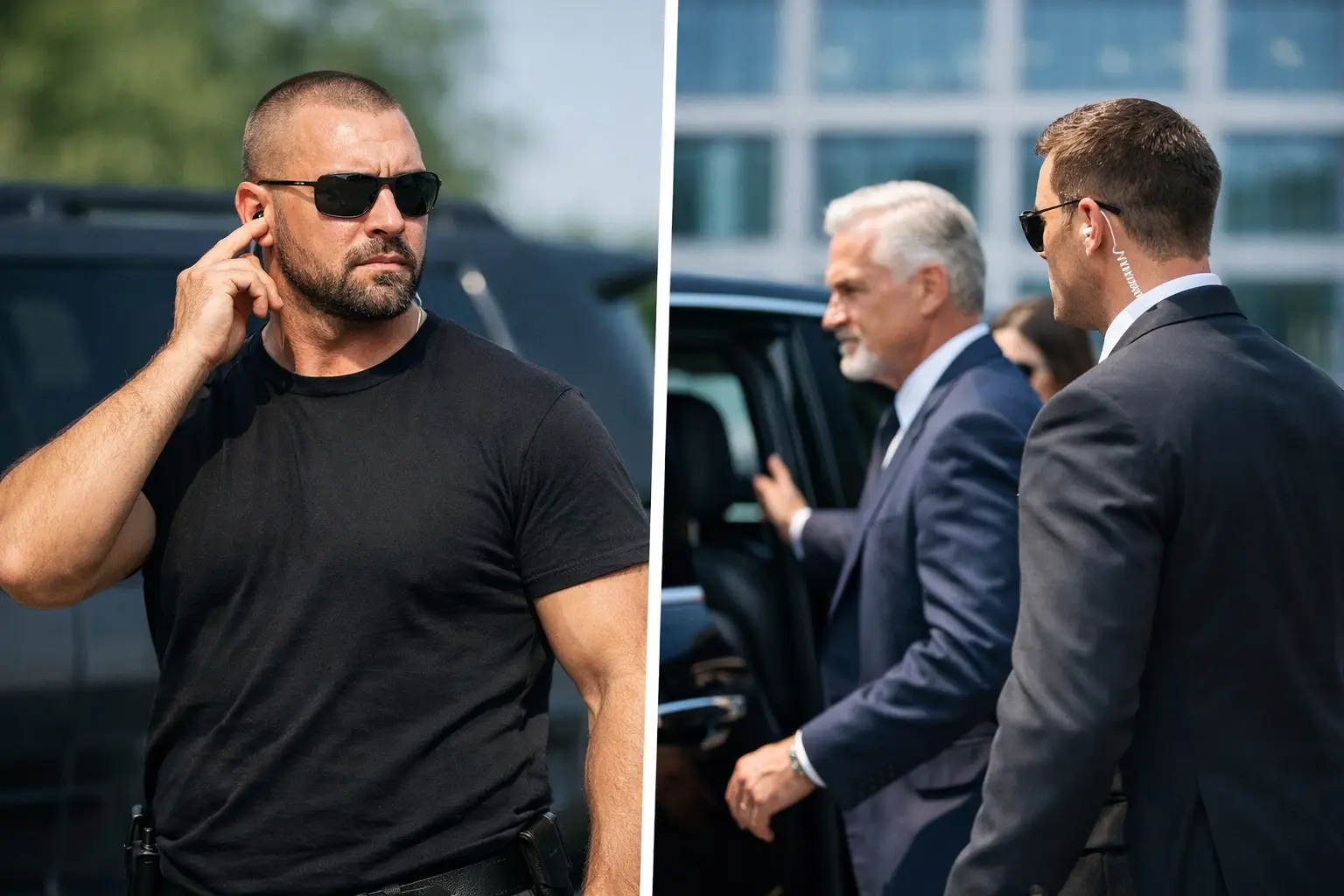
A bodyguard, often referred to professionally as a personal protection officer, is primarily focused on the immediate safety of an individual. Their work is close, practical and often highly visible when circumstances require it. They may accompany a client through public appearances, functions, travel movements, media engagements or periods of elevated concern.
The central task is to identify danger in the immediate environment and act decisively to prevent or manage it. This can include controlling physical proximity, monitoring approaches, selecting safe positions, assisting a client into and out of vehicles, and responding to confrontation or emergency situations.
A quality bodyguard is not simply a large presence at someone’s shoulder. Professional personal protection requires judgement, composure, communication skills and the discipline to remain unobtrusive unless intervention is needed. For a music artist moving between airport, accommodation, rehearsals and a public performance, for example, a personal protection officer may be exactly the right deployment.
This model is often suitable where the risk is concentrated around particular appearances, a known individual is receiving unwanted attention, or a client needs immediate protective support for a defined period. The scope can be highly effective, but it is generally person-centred and close-protection focused.
Executive protection services manage the wider picture
Executive protection is a broader risk-management discipline. It combines personal protection with planning, intelligence, logistics, advance work and ongoing assessment. The protective operative remains important, but they are one part of a coordinated security operation.
The objective is not merely to respond well when something goes wrong. It is to reduce the likelihood of disruption before the client arrives. This calls for an understanding of threats, vulnerabilities, travel arrangements, locations, schedules, personnel and public exposure.
An executive protection assignment may involve an advance assessment of offices, hotels, venues and transport routes. It may require discreet liaison with event organisers, corporate staff, drivers and venue security. It can include background enquiries, threat monitoring, contingency planning and a clear incident escalation process. When a principal is travelling between Auckland, Wellington and Christchurch, or entering a complex overseas environment, these details become operationally significant.
Executive protection is therefore well suited to senior leaders facing contentious business activity, public scrutiny, workplace tensions, targeted harassment or travel-related exposure. It is also relevant when a family office, government-adjacent organisation or international delegation requires protective coverage that does not interfere with daily operations.
Bodyguard versus executive protection services: the practical differences
The distinction is best understood through scope, preparation and control.
A bodyguard deployment may begin with a clear immediate requirement: escort a client safely through an event, remain with them during a public appearance or provide protection while a specific concern is active. The officer observes the environment and protects the client in real time.
Executive protection starts earlier. It asks who may present a risk, where exposure is most likely, what information is available publicly, how the client’s itinerary affects vulnerability and what support is needed at each location. It then puts proportionate controls around the person, rather than relying on a close-protection presence alone.
Visibility is another difference. A bodyguard may need to be apparent to deter interference and create personal space. Executive protection can be overt, low-profile or a blend of both. A board chair attending a sensitive meeting may need an unobtrusive protective professional nearby, while a celebrity appearance may warrant a more visible team to manage crowd pressure.
Neither model is automatically superior. A visible bodyguard can be the right answer for a short, clearly defined engagement. A full executive protection programme may be excessive for an individual who only needs safe movement through a single event. Conversely, assigning one officer without advance planning may be inadequate where the risk involves multiple locations, persistent unwanted contact, complex travel or a high consequence incident.
When executive protection becomes the stronger choice
Executive protection is generally the more appropriate service when the principal’s exposure is connected to their role, commercial activity or public profile rather than a single occasion. A chief executive handling a restructure, a founder involved in a high-value dispute, or an executive visiting unfamiliar sites may face risk that changes across time and locations.
It is also the stronger choice where disruption could affect more than the individual. An incident involving a senior leader can interrupt negotiations, compromise confidential information, unsettle staff and cause reputational damage. In these situations, the protective plan must consider the business as well as the person.
Travel is a common trigger. A close-protection officer can accompany a client, but executive protection addresses the travel operation itself: arrival points, vehicle arrangements, accommodation, meeting locations, route alternatives, local support and emergency contingencies. This is especially valuable for visiting talent, sports teams and overseas executives whose schedules are compressed and highly visible.
The same principle applies to family protection. A family may not want overt security at every movement, yet may require assessed procedures for residences, school routines, events, staff access and online exposure. Sophisticated handling means applying the least intrusive measure that still provides credible control.
What to assess before appointing a provider
The quality of the people deployed matters, but protection should not be purchased on personnel claims alone. Decision-makers should assess how the provider evaluates risk, plans operations and maintains accountability.
First, confirm appropriate New Zealand government licensing under the Private Security Personnel and Private Investigators Act framework. Licensing is a baseline, not a complete measure of capability, but it is essential. Ask who will lead the assignment, what relevant experience they bring and how the provider vets its personnel.
Second, test the provider’s planning process. A credible executive protection partner should be able to explain how it conducts a threat and vulnerability assessment, sets a protective posture, communicates with relevant stakeholders and adjusts the plan when circumstances change. Generic assurances are not enough for sensitive work.
Third, consider discretion. Protection personnel may see confidential movements, personal relationships, commercial discussions and family routines. The provider must demonstrate disciplined information handling, clear reporting lines and an understanding of when not to be seen.
Finally, look for integrated capability. A personal protection requirement can quickly involve event security, secure transport coordination, private investigation, workplace security advice or incident management. A provider able to coordinate these functions under one operational plan reduces handovers and preserves control.
Protection that supports the principal, not the spectacle
The strongest protective work is often the least noticeable. It enables a leader to attend meetings, a performer to engage with fans, or a family to maintain ordinary routines with confidence that the relevant risks have been assessed and managed.
That outcome depends on matching resources to the threat. An imposing presence without preparation can create attention without solving the underlying problem. Equally, a detailed plan without experienced personnel on the ground can fail at the decisive moment. Effective protection combines disciplined people, current intelligence, practical logistics and sound judgement.
TNG Security approaches personal protection and executive care as a managed operation, drawing on licensed, vetted personnel and broader security, investigation and risk-management capability when the situation demands it. The emphasis is on absolute precision, not unnecessary theatre.
Before appointing a bodyguard or commissioning executive protection, define what must be protected: the person, their movements, their privacy, their reputation, their organisation or all of these together. A clear assessment at the outset gives protective professionals the information needed to deliver calm, credible protection without compromising the life or work that matters most.
Latest Posts
Aug. 22, 2026
When Are Security Guards Required in New Zealand?
Aug. 22, 2026
Bodyguard Versus Executive Protection Services
Aug. 22, 2026
Security for Events That Protects More Than People

Aug. 22, 2026
When Security Consultants Become Essential

Aug. 21, 2026