
A successful event can take months to build and only minutes to compromise. For organisers, venue operators and corporate leaders, security for events is not simply a visible guard at the door. It is the disciplined management of people, access, information, assets and emerging risk – before a minor issue becomes an operational, safety or reputational failure.
Whether the occasion is a corporate function, public festival, product launch, sporting fixture, conference, private celebration or high-profile appearance, the security posture must match the real risk. That requires more than manpower. It requires intelligence-led planning, elite personnel, clear command structures and the judgement to act with absolute precision.
Why event security must start before guests arrive
The most effective security operation is often the least visible. Guests should experience a well-run event, not an atmosphere of unnecessary restriction. Achieving that balance depends on planning well before doors open.
A proper assessment considers the venue layout, expected attendance, guest profile, entry and exit points, alcohol service, transport movements, cash or high-value equipment, nearby activity and the potential for disruption. It also considers the event’s public profile. A private executive dinner and a ticketed music event may both require access control, but their threat exposure, staffing model and response requirements are fundamentally different.
Security planning should also account for issues that are not always obvious in a standard event checklist. These may include a targeted individual, a former employee, activist attention, unwanted media interest, online threats, theft opportunities, protests, domestic violence concerns or a VIP whose movements require privacy. Sophisticated risk handling means identifying these factors early and putting proportionate controls in place without disrupting the purpose of the event.
This is where a security provider’s operational depth matters. Guards can manage a checkpoint. Experienced security and risk management specialists can help design the checkpoint, determine what it needs to achieve, establish escalation protocols and integrate it with the wider operation.
The event security plan should reflect the risk
There is no responsible one-size-fits-all deployment. Overstaffing can make an event feel overly controlled and add avoidable cost. Understaffing can leave organisers exposed when conditions change. The right solution is based on the environment, people and credible threats.
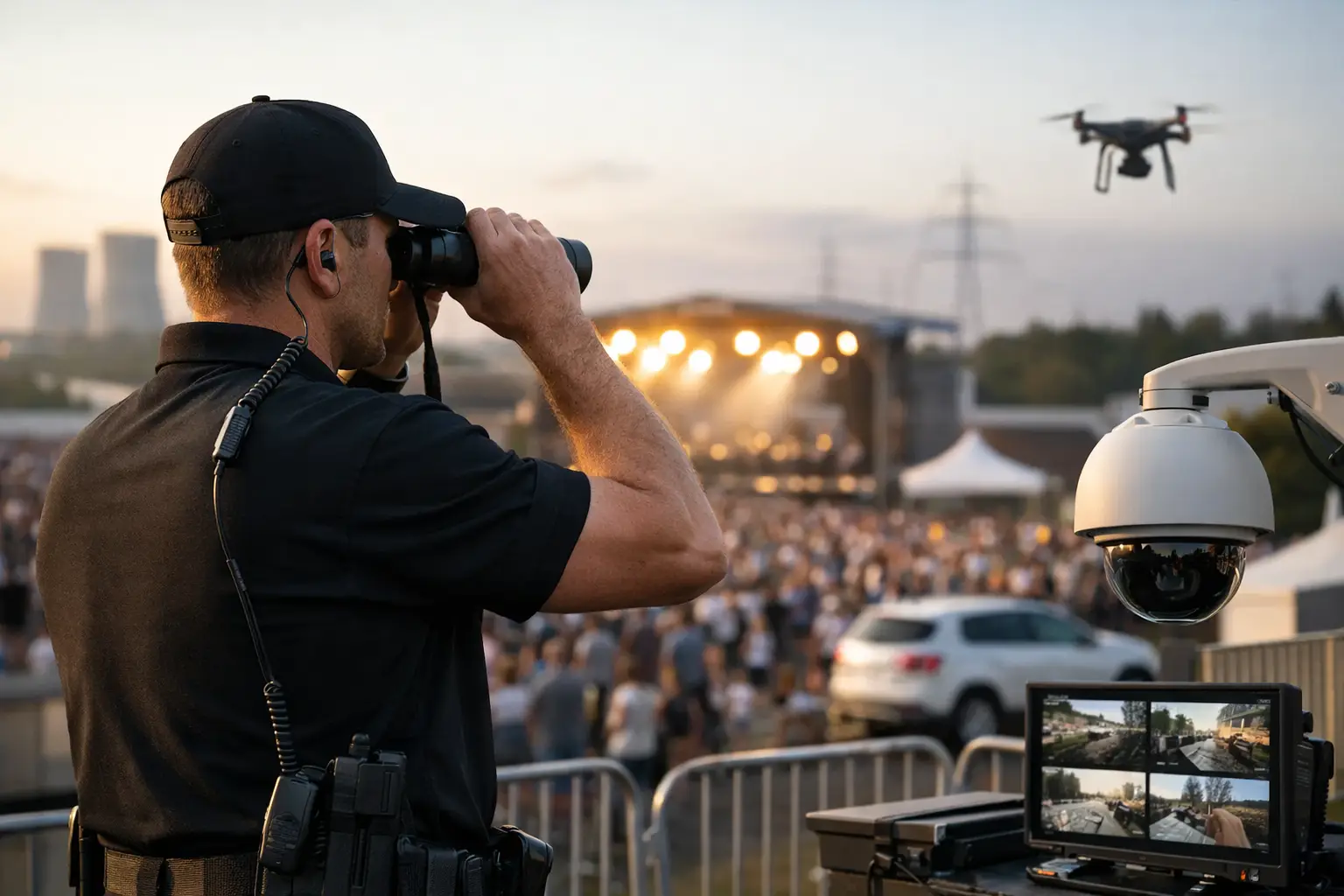
For a corporate awards evening, the priority may be discreet guest screening, executive movement, protection of valuables and a measured response to intoxication or unwanted attendees. A large public event may require layered entry control, bag-check procedures where appropriate, queue management, roving patrols, backstage security, emergency access management and a visible command presence.
For high-profile talent, international visitors or senior executives, event security may need to extend beyond the venue. Advance work can include travel coordination, secure arrival and departure routes, hotel liaison, credential management, close personal protection and privacy measures. The aim is not to isolate the client from the event. It is to allow them to participate confidently while their exposure is professionally managed.
A sound plan defines who is responsible for each area, how concerns are reported, who can make decisions and when police, medical services, fire personnel or venue management must be engaged. In a live incident, ambiguity costs time. Clear operational control protects people and preserves the organiser’s ability to make informed decisions.
Access control is more than checking a ticket
Entry points are where many event risks first appear. Effective access control confirms not only who is permitted to enter, but also where they are permitted to go and under what conditions.
Credential systems should distinguish between guests, staff, contractors, suppliers, media, performers and restricted-area personnel. This is particularly important where there are green rooms, control rooms, loading docks, cash handling areas, executive spaces or sensitive technical infrastructure. A pass that is easy to copy, poorly checked or inconsistently enforced creates a weak point that can be exploited.
Professional personnel combine courtesy with firm boundaries. They can manage a guest who has arrived without the correct accreditation, identify behaviour that warrants further attention and maintain a calm, respectful tone under pressure. The objective is compliance without confrontation wherever possible.
Crowd management requires judgement, not force
Crowd pressure, intoxication, frustration and poor communication can escalate quickly. The most reliable response is usually early intervention: spotting a developing issue, separating parties, adjusting flows, communicating expectations and bringing in the right decision-maker before the situation hardens.
This calls for personnel who understand body language, de-escalation, venue dynamics and lawful, proportionate intervention. Physical action may occasionally be necessary to protect people, but it is never the starting point. Every intervention should be controlled, documented and aligned with the event plan and applicable legal obligations.
Good crowd management also protects the guest experience. Clear queues, well-managed entrances, accessible exits and a visible but approachable security presence reduce confusion. When people understand where to go and what is expected, friction falls markedly.
Protect the operation, not only the perimeter
Event risk is not limited to the front gate. Theft, unauthorised access, equipment damage, staff misconduct, lost property, credential misuse and information leakage can occur backstage or during pack-in and pack-out, when attention is often focused elsewhere.
Security coverage should therefore consider loading areas, vehicle movements, contractor access, temporary storage, control points and high-value assets. It may also include secure handling arrangements for sensitive documents, devices, gifts, merchandise or production equipment.
For corporate and government-adjacent events, discretion is especially important. A security team may be handling guest lists, executive schedules, confidential discussions and movements that should not become public. Personnel must understand that privacy is a security requirement, not simply a courtesy. Professional conduct includes knowing what not to discuss, photograph or disclose.
The same principle applies after an incident. Accurate reporting, preservation of relevant information and a measured communication process help clients understand what occurred and determine the appropriate next step. A rushed or poorly documented response can create legal, insurance and reputational consequences long after the event has ended.
What to expect from a credible event security provider
A provider should be able to explain its planning process in direct operational terms. Ask how it assesses risk, selects personnel, briefs the team, manages incident escalation and coordinates with venue management and emergency services. Ask whether it can provide security beyond the event floor when executives, talent or sensitive assets require additional protection.
Government licensing, proven experience and robust personnel vetting are essential foundations. However, credentials alone are not enough. The standard of the individual on site matters: their judgement, communication, presentation, awareness and ability to make sound decisions in fast-changing circumstances.
The strongest teams are prepared without becoming rigid. They work to a clear plan, yet understand that events are dynamic. A delayed speaker, unexpected crowd surge, medical event, weather change or unplanned VIP arrival can alter priorities immediately. The security operation must adapt while maintaining calm, accountability and uncompromised standards.
TNG Security provides event and venue security through a service model built around licensed professionals, operational planning and sophisticated handling of complex risk. From discreet corporate functions to high-attendance public occasions, the focus remains the same: protect people, preserve operational integrity and allow the event to proceed with confidence.
Security is part of the event experience
Guests may not remember every detail of an event, but they will remember whether it felt safe, organised and professionally managed. That outcome is created through quiet preparation, capable people and decisive leadership when it matters.
When planning your next event, treat security as an operational partner from the outset rather than a late-stage compliance item. The right team will protect far more than the venue perimeter – it will help protect the confidence, reputation and purpose behind the occasion.
Latest Posts
Aug. 22, 2026
When Are Security Guards Required in New Zealand?

Aug. 22, 2026
Bodyguard Versus Executive Protection Services
Aug. 22, 2026
Security for Events That Protects More Than People

Aug. 22, 2026
When Security Consultants Become Essential
Aug. 21, 2026