
Security is often purchased after something has gone wrong: a break-in at a construction site, aggressive behaviour at a venue, a data or asset loss, a threat made against a senior executive, or an incident that exposes a gap in operational control. By then, the question is no longer whether protection was needed. It is whether the right risk decisions were made early enough.
For corporate, businesses, organisations and private clients, effective security is not simply a roster of security guards at a gate. It is a managed capability that identifies exposure, applies proportionate controls and provides a disciplined response when conditions change. The quality of that capability determines whether security becomes a visible cost or a meaningful safeguard for people, property, reputation and continuity.
Security begins with the risk, not the uniform
A uniformed security presence can be valuable. It can deter opportunistic crime, reassure staff and customers, control access and provide an immediate point of contact during an incident. But visibility alone is not a security strategy.
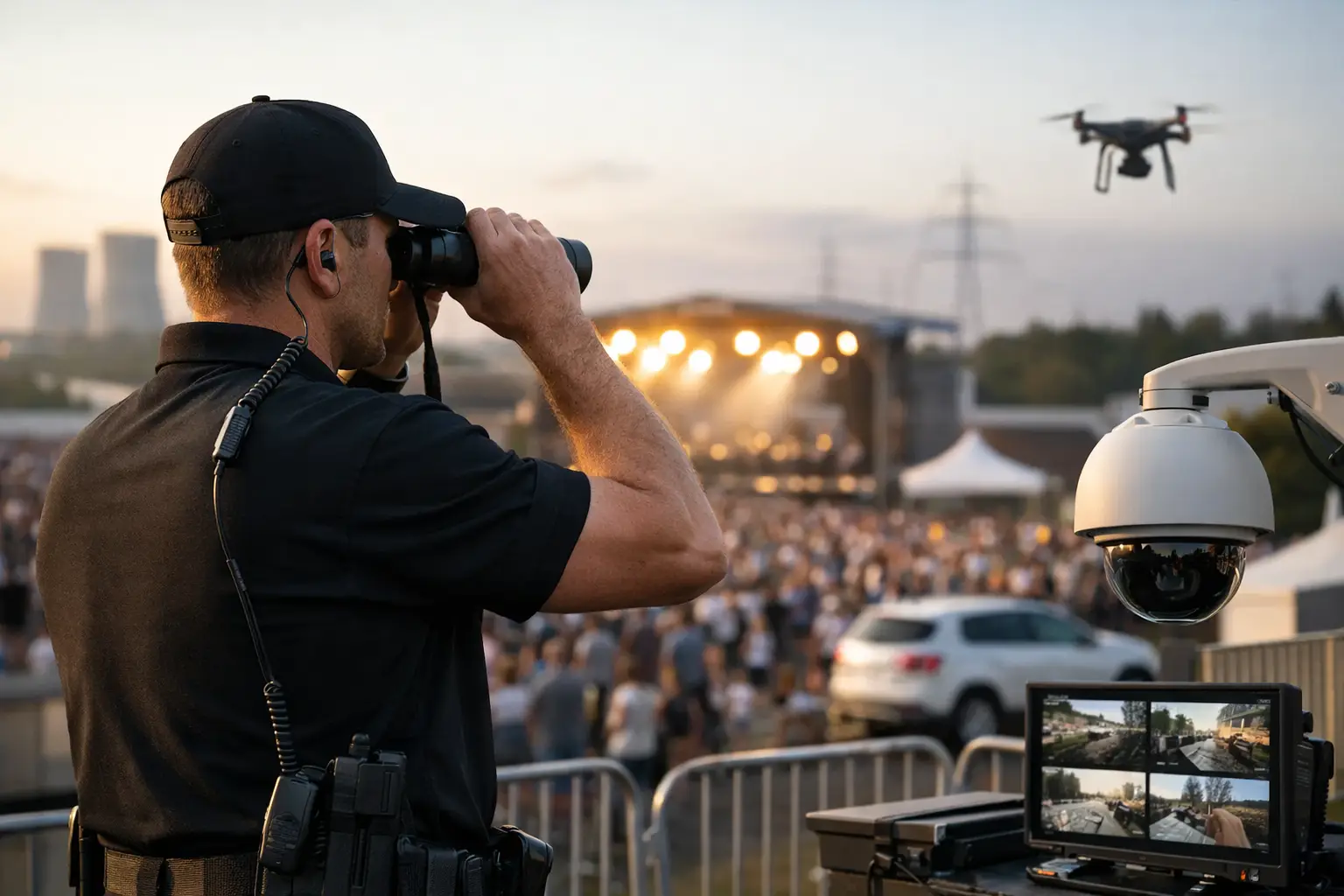
The appropriate response depends on what is at stake. A corporate office may need discreet access control, visitor management and after-hours patrols. A vacant commercial property may require asset protection, alarm response coordination and intelligence around recurring intrusion. A major event needs crowd behaviour assessed before gates open, not merely managed once pressure builds at the entry point.
The same principle applies to personal protection. An executive, public figure or visiting artist does not necessarily need a conspicuous close-protection detail. They may need secure movement between locations, advance planning, privacy at accommodation, careful liaison with venues and the ability to adapt quickly to unwanted attention or a credible threat. Protection should support the client’s life and work, not unnecessarily disrupt it.
This is why a proper assessment matters. It considers the asset or person being protected, the likely threats, known vulnerabilities, operating environment and consequences of failure. It also considers what normal activity must continue. Security that stops a business trading, prevents guests enjoying an event or makes staff feel monitored rather than supported has missed part of the brief.
The cost of treating security and protection as a commodity
When security is assessed on the lowest hourly rate alone, critical differences can disappear from view. Personnel screening, government (PSPLA) licensing, supervision, training, reporting standards, escalation procedures and management oversight all affect the outcome. They also affect what happens in the difficult minutes after an incident begins.
A poorly organised and managed team may be physically present yet unable to recognise early warning signs, communicate clearly, preserve evidence or make appropriate decisions under pressure. Conversely, experienced personnel working to a clear operational plan can de-escalate an issue before it becomes disruptive, violent or reputationally damaging.
There is a commercial trade-off. Not every site requires a specialist team around the clock, and over-resourcing can waste budget. However, under-resourcing a high-risk environment can create losses that far exceed the apparent saving. The objective is not the maximum number of people on site. It is the correct level of capability, deployed at the right times, with accountable management behind it.
For decision-makers, that means asking more useful questions than “How many security guards do we get?” Ask who is responsible for the risk assessment, how personnel are selected and briefed, what support they receive during a shift, and how incidents are documented and reviewed. These questions reveal whether a provider is supplying labour or delivering professional protection.
Intelligence turns information into control
Many security failures are preceded by signals: repeated probing of access points, unusual visitor behaviour, online threats, staff concerns, theft patterns or changes in local conditions. Individually, these can appear minor. Taken together, they may indicate a growing risk.
Intelligence-led security gives those signals context. It does not mean dramatic surveillance or speculation. It means gathering lawful, relevant information, testing its reliability and using it to guide decisions. For a property owner, this may identify the time, method and target of recurring theft.
For a business or corporate client in New Zealand, it may clarify the nature of a threat before executive travel or a contentious event. For a private client, it may help separate unwanted attention from a genuine personal-security concern.
Private investigation capability can be particularly valuable where facts are unclear. Internal misconduct, asset diversion, fraudulent activity and sensitive personal matters demand discretion as well as method.
An investigation must be lawful, evidence-based and managed in a way that protects confidentiality. Poorly handled enquiries can compromise evidence, expose an organisation to legal risk and damage trust among staff or stakeholders.
The operational benefit is simple: decisions improve when they are based on credible information. Resources can then be directed towards actual exposure rather than assumptions.
Why security plans fail in practice
A plan can look comprehensive on paper and still fail at the point of delivery. The most common cause is a gap between planning and operations. Instructions may be unclear, site knowledge may be limited, or personnel may not understand who has authority to make decisions when an incident develops.
Effective planning sets out more than post orders. It defines access arrangements, communication channels, emergency escalation, roles for client staff and security personnel, reporting requirements and thresholds for police, emergency services or specialist support. For events, it should also account for crowd density, alcohol service, artist or VIP movement, transport, weather and the possibility of a rapid evacuation.
A plan must be tested against real conditions. Can a team communicate if mobile coverage is poor? Is there a safe location for staff to withdraw to? Does the control room have current contact details? Are contractors, cleaners and delivery drivers included in access procedures?
Small operational details often create the largest gaps.
Regular review is equally important. A site that was low risk six months ago may have changed through staffing movements, public visibility, construction activity, new tenants or heightened community tension. Security needs to evolve with the operating environment.
Professional conduct is part of the protection
Security personnel often interact with employees, customers, guests, contractors and members of the public at moments of stress. Their judgement and manner shape how the venue, business or organisation is perceived. This is particularly significant in hospitality, retail, corporate workplaces, public-facing facilities and high-profile events.
Professionalism does not mean passivity. It means remaining calm, observant and decisive while using appropriate communication and lawful authority. The best intervention is often the one that resolves a problem quietly, preserves dignity and prevents unnecessary escalation.
That standard relies on recruitment, training and supervision. Security professionals with backgrounds in military, intelligence or law-enforcement environments may bring valuable operational discipline, but experience must still be matched to the assignment. A close-protection officer (bodyguard), private investigator, security consultant, event security operator and security guard require different skills, temperaments and responsibilities.
Government licensing also matters. In New Zealand, clients should expect security services to operate within the requirements of the Private Security Personnel and Private Investigators Act framework. Government (PSPLA) licensing is not a substitute for quality, but it is a baseline indicator of legitimacy and accountability.
Security that protects operational integrity
For most clients, the desired outcome is not a dramatic intervention. It is a normal day: staff arrive safely, assets remain protected, an event runs to schedule, an executive completes their programme without disruption and a sensitive matter is handled discreetly.
That outcome requires coordination. Security may need to work alongside facilities teams, health and safety leaders, event organisers, venue management, legal advisers, HR, insurers and public agencies. Each group sees risk through a different lens. A capable and reputable PSPLA licensed security partner brings these strands together without creating unnecessary complexity.
TNG Security approaches this work as an integrated service, combining government (PSPLA) licensed frontline security professionals with risk management, private investigation and protective services planning where the assignment requires it. This model is particularly relevant when a straightforward guard deployment is not enough, or when a client needs one accountable team to manage a sensitive and evolving situation.
The measure of success is not how often a security team is seen taking action. It is whether threats are identified early, incidents are contained professionally and the client retains control of their environment.
Choosing the level of security and protection your situation requires
The right approach begins with a frank discussion about exposure. Consider the value and criticality of the assets involved, the profile of the people present, the location, previous incidents, public access, operating hours and the potential consequences if an issue is mishandled. A central Auckland venue during a high-attendance event faces different pressures from a Christchurch industrial site after hours or a Wellington executive attending a public meeting.
From there, security can be scaled with precision. It may involve a visible presence, mobile security patrols, access management, event security teams, close personal protection, private investigation, security consulting or a combination of services. The answer should be proportionate, lawful and designed around the client’s operational reality.
The most valuable security conversation is not about filling a post. It is about understanding what must not be allowed to fail – and putting experienced people, clear intelligence and disciplined planning around it before the risk decides the terms.
Latest Posts
Aug. 22, 2026
When Are Security Guards Required in New Zealand?

Aug. 22, 2026
Bodyguard Versus Executive Protection Services
Aug. 22, 2026
Security for Events That Protects More Than People

Aug. 22, 2026
When Security Consultants Become Essential
Aug. 21, 2026