
An executive’s exposure rarely begins at the office door. It may emerge through an unwanted visitor in reception, an employee grievance, a public event, a predictable travel routine or a social media post that reveals more than intended. Knowing how to manage executive security means treating protection as a disciplined risk-management function, not a visible show of force.
For boards, senior leaders, high-profile private clients and government-adjacent organisations, the objective is clear: preserve safety, privacy and operational continuity without disrupting legitimate business activity. The right approach is proportionate, intelligence-led and discreet. It protects the individual while respecting their role, schedule and public profile.
Start with an executive risk assessment
Executive security and personal protection should never be based solely on title, wealth or public visibility. A chief executive who travels between Auckland, Wellington and Christchurch may face a very different risk profile from a founder involved in a contentious transaction, a public figure attending crowded events, or a leader managing a workplace dispute.
A structured risk assessment establishes what needs protecting, who or what may present a risk, and how likely a threat is to materialise. This process should consider personal exposure alongside organisational risk. Known threats, disgruntled parties, litigation, activism, media attention, online harassment, travel patterns, family considerations and public appearances can all affect the required protective posture.
The risk assessment must also identify vulnerabilities. These may include regular routes, unsecured home or workplace access, unplanned public engagements, insufficient visitor management, overly broad access to executive diaries, or travel arrangements that are easily observed. The purpose is not to create unnecessary restrictions. It is to remove predictable weaknesses before they are exploited.
Good executive risk management is reviewed regularly. Risk changes quickly after a corporate announcement, restructuring, incident, high-profile court matter or shift in public attention. A static plan is often a false assurance.
How to manage executive security and personal protection at the right level
Executive security and personal protection should match the threat environment. Constant executive security and personal protection is appropriate for some people and periods, but it is not the default answer to every executive risk. An overt protection detail can affect meetings, staff dynamics, public perception and personal comfort. Conversely, an under-resourced arrangement may leave an executive exposed when circumstances escalate.
A proportionate model may involve protective services, intelligence, investigations, surveillance, secure transport planning, advance work before significant engagements, residential security advice, executive journey management and trained personnel on standby. Where direct protection is required, personal protection officers should be selected for judgement, discretion and the ability to operate calmly around senior stakeholders.
The distinction matters. A capable executive security and personal protection professional is not simply a security guard positioned nearby. They assess the environment, manage movement, identify anomalies, communicate clearly and make sound decisions under pressure. Their presence should support the executive’s day, not take it over.
For a leader attending a shareholder meeting or public-facing event, this may mean an advance assessment of access points, entry and exit routes, parking, crowd flow and medical contingencies. For an executive travelling overseas, it may involve vetted drivers, accommodation assessment, itinerary discipline, local intelligence and contingency arrangements. The level of protective support depends on the assessed risk and the consequences of disruption.
Build security and personal protection into the executive’s routine
The most effective arrangements are practical enough to be followed. If a security plan makes every meeting difficult or imposes rules that cannot be maintained, people will work around it. Executive security must fit real operating conditions while still setting non-negotiable boundaries where risk demands them.
Start with basic controls around diaries, travel and communications. Access to an executive’s movements should be limited to people with a genuine operational need to know. Calendar information, flight details, hotel bookings and private addresses should not circulate casually through email chains or shared systems. Staff who support senior leaders need clear protocols for handling sensitive information and unexpected visitors.
Workplaces also require reliable front-of-house procedures. Reception teams, facilities managers and executive assistants are frequently the first to see concerning behaviour. They should know how to verify visitors, escalate threats, preserve evidence and communicate with security personnel without causing unnecessary alarm.
At home, the standard should be equally considered. Residential protection is not about turning a family home into a fortress. It may involve access control, lighting, camera coverage, alarm response, household staff protocols, secure delivery processes and practical advice for family members. The appropriate measures depend on location, profile, known threats and daily routine.
Protect information as carefully as people
Executive exposure is increasingly shaped by information. A physical protection plan can be undermined when schedules, locations, family details or travel plans are shared online, exposed through a data breach or disclosed by an unwitting third party.
This requires close coordination between security, executive support staff, IT and communications teams. Cybersecurity teams may identify compromised accounts or targeted impersonation. Corporate security may assess physical access and suspicious approaches. Communications advisers can manage public messaging when an incident risks attracting further attention. These functions should not operate in isolation.
A practical protocol should cover social media use, event photography, public itinerary announcements, handling of hostile messages and the reporting of doxxing or impersonation attempts. It should also establish who has authority to make decisions if a threat emerges outside business hours. Delay and confusion are common failure points in executive incidents.
Plan movement, travel and public engagements
Travel creates exposure because it places an executive in unfamiliar environments with less control over access, timing and local support. Even routine domestic travel needs sound preparation where risk is elevated. This includes confirmed transport, secure collection points, alternative routes, communication checks and a clear process for changes to the itinerary.
For international travel, planning should begin well before departure. Country risk, local political conditions, crime patterns, medical support, accommodation location, ground transport and emergency contacts all require consideration. It may be necessary to arrange advance visits, local protective support or a close protection officer who remains with the executive throughout the journey.
Public appearances demand similar discipline. A venue security plan should account for crowd management, restricted areas, backstage access, credential control, protest activity, emergency exits and extraction options. The executive’s security and personal protection team should agree in advance how to respond to interruptions, aggressive questioning or an urgent departure. Quiet preparation prevents visible confusion.
Select security professionals with the judgement to lead
The quality of personnel determines whether executive security and personal protection feels controlled or intrusive. Look beyond physical presence. Trained security and risk management professionals assigned to high-trust protective work must be appropriately licensed, carefully vetted and experienced in confidentiality, conflict management, emergency response and client-facing conduct.
They must also understand that protection involves service. An executive may need to move between a board meeting, media engagement, airport lounge and private family commitment in a single day. The protection team needs absolute precision, but also the interpersonal awareness to work around assistants, drivers, event staff, corporate stakeholders and family members.
For complex requirements, an integrated security provider can bring together executive security and personal protection, private investigation, intelligence, venue security, event security and risk management services. This is particularly valuable when a threat has unclear origins or when workplace, residential and travel risks overlap. TNG Security applies this integrated approach through New Zealand government (PSPLA) licensed security personnel (bodyguards, security consultants, private investigators, risk management specialists) and sophisticated operational planning tailored to the client’s circumstances.
Test the response before it is needed
A plan that has not been tested may fail at the moment it matters. Executive security and personal protection teams should rehearse the decisions most likely to create pressure: a threatening person at reception, a suspicious package, a protest outside a venue, a compromised travel plan, an online threat, or an incident involving a family member.
Testing does not need to be theatrical. A short scenario discussion can reveal whether key people know who to call, where to move, what information to share and who has authority to act. After any incident or exercise, review the response with candour. Were instructions clear? Did personnel have the information they needed? Did the response preserve safety and dignity?
Executive security and personal protection is strongest when it becomes a quiet habit of leadership: informed decisions, trusted people, controlled information and rehearsed action. The right protective arrangement gives leaders room to lead, confident that risk is being handled with discipline and discretion.
Latest Posts
Aug. 25, 2026
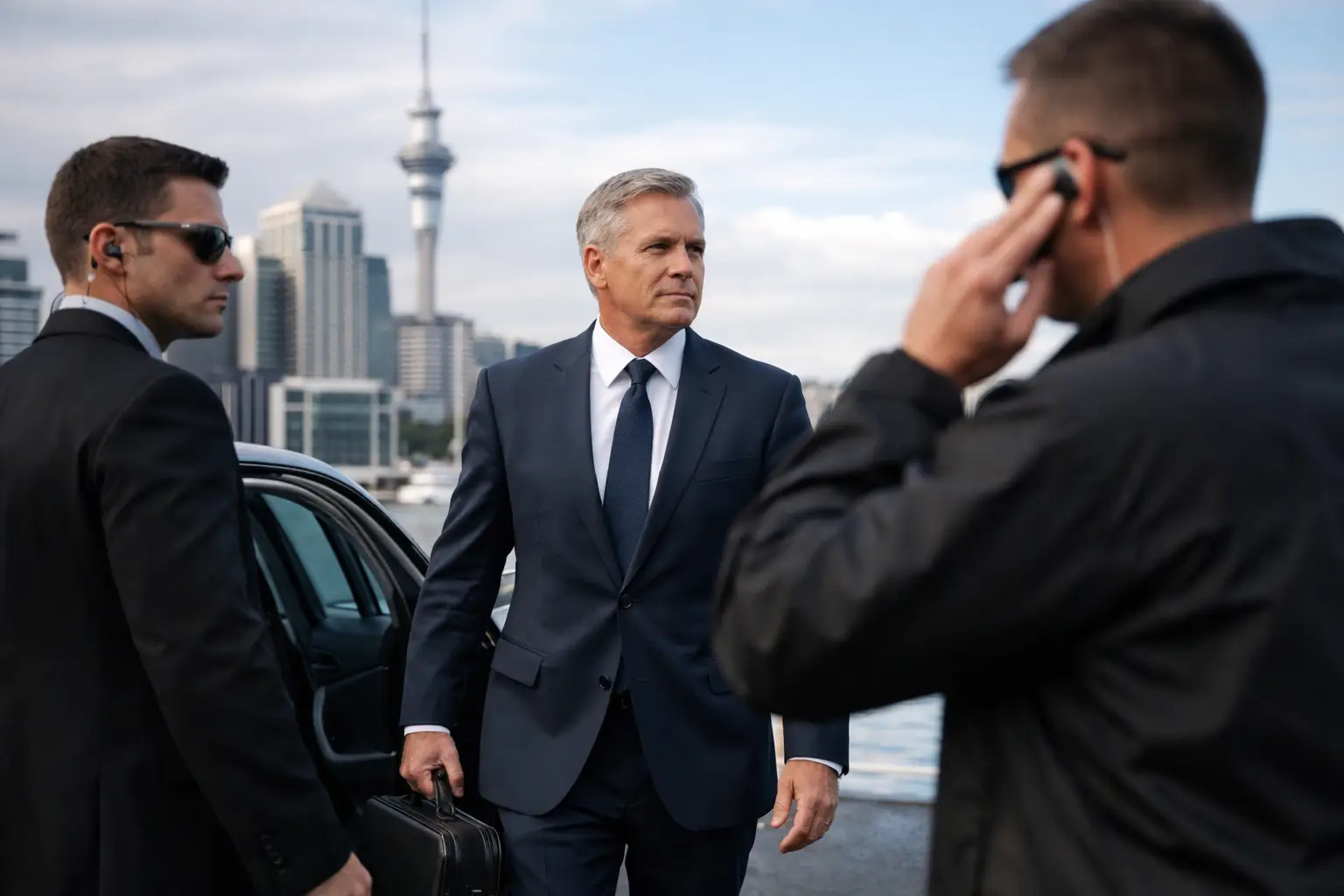
Best Security Protocols for Executives in NZ
Aug. 24, 2026
Venue Safety Requirements for New Zealand Events
Aug. 22, 2026
When Are Security Guards Required in New Zealand?

Aug. 22, 2026
Bodyguard Versus Executive Protection Services
Aug. 22, 2026