
A public appearance, a sensitive restructuring, an employment dispute or a high-value transaction can change an executive’s risk profile with very little warning. The best security protocols for executives do not begin with a visible guard at the door. They begin with a precise understanding of exposure, then apply proportionate protection that preserves privacy, mobility and operational control.
For senior leaders, security failures rarely remain personal. A targeted incident can affect staff confidence, business continuity, confidential information, shareholder value and reputation. Effective executive security therefore needs to operate as a disciplined programme, not a collection of reactive measures.
Best security protocols for executives start with intelligence
Executive protection should be driven by assessed risk, not status or appearance. A chief executive who travels frequently, makes public decisions and is managing a contentious issue has a different exposure profile from a director whose primary risk is digital compromise or unwanted contact at home.
A professional assessment considers the individual’s public visibility, routine travel, family circumstances, workplace and residential environments, online footprint, current disputes, event commitments and known threat indicators. It should also examine the organisation’s wider context: redundancies, litigation, regulatory action, industrial issues, controversial projects or public campaigns can all elevate risk.
This is not about treating every executive as though they face an imminent threat. Over-protection can be disruptive, expensive and counterproductive. Under-protection leaves gaps that are often recognised only after an incident. The correct posture is scalable: increased controls during a period of heightened exposure, with discreet baseline measures maintained when the risk recedes.
A reviewed threat and vulnerability assessment gives leaders a defensible basis for security decisions. It clarifies what is being protected, who may pose a concern, where exposure occurs and how personnel should respond. Without this foundation, even capable security resources can be deployed in the wrong place.
Establish one clear security operating picture
Executives often move between offices, board meetings, airports, hotels, sites, events and private commitments. Each location may have separate staff, systems and procedures. Fragmentation creates uncertainty during a disruption.
A single security operating picture brings together relevant information without circulating sensitive details unnecessarily. It should identify approved points of contact, escalation pathways, travel movements on a need-to-know basis, venue contacts, medical considerations, communications arrangements and contingency options. The aim is not constant monitoring. It is informed coordination.
The executive, executive assistant, corporate security lead and protection team should understand their respective responsibilities before an incident occurs. For example, an assistant may manage schedule changes and guest access, while a security lead assesses a concerning message and coordinates the response. When responsibilities overlap or remain vague, precious time is lost.
This operating picture must be regularly updated. A new home address, revised travel pattern, emerging workplace issue or social-media exposure can alter the risk calculation. Stale information is a common weakness in otherwise well-resourced security arrangements.
Protect privacy through disciplined information handling
Senior people are frequently exposed through information rather than physical proximity. Travel itineraries, residential details, family names, vehicle registrations, meeting locations and private mobile numbers should not be broadly available through convenience or habit.
Apply access controls based on operational need. Limit who can see live schedules. Require staff and suppliers to follow clear confidentiality expectations. Review how visitor logs, event registrations, shared calendars and delivery records are handled. These small controls reduce the opportunity for unauthorised parties to build an accurate picture of an executive’s movements.
Digital hygiene deserves equal attention. Executives should use multi-factor authentication, unique passwords managed appropriately, prompt software updates and verified channels for sensitive requests. Finance teams and assistants need procedures to validate urgent payment, document or access requests that appear to come from a senior leader. Executive impersonation is persuasive because it exploits authority and time pressure.
Make travel security deliberate, not burdensome
Travel creates predictable points of exposure: arrivals, departures, transfers, accommodation, public appearances and last-minute schedule changes. A suitable travel protocol balances safety with the executive’s need to work and move efficiently.
Before higher-risk travel, conduct a destination and itinerary review. Consider local conditions, venue access, transport arrangements, protest activity, media interest, medical support, accommodation security and communications coverage. Confirm who will meet the executive, how identity will be verified and what will happen if a flight is delayed or a venue becomes unsuitable.
Travel plans should include practical alternatives. These may involve a secondary route, backup transport, another meeting location or authority to cancel an engagement if conditions deteriorate. Contingencies are not signs of alarm. They are evidence of sound planning.
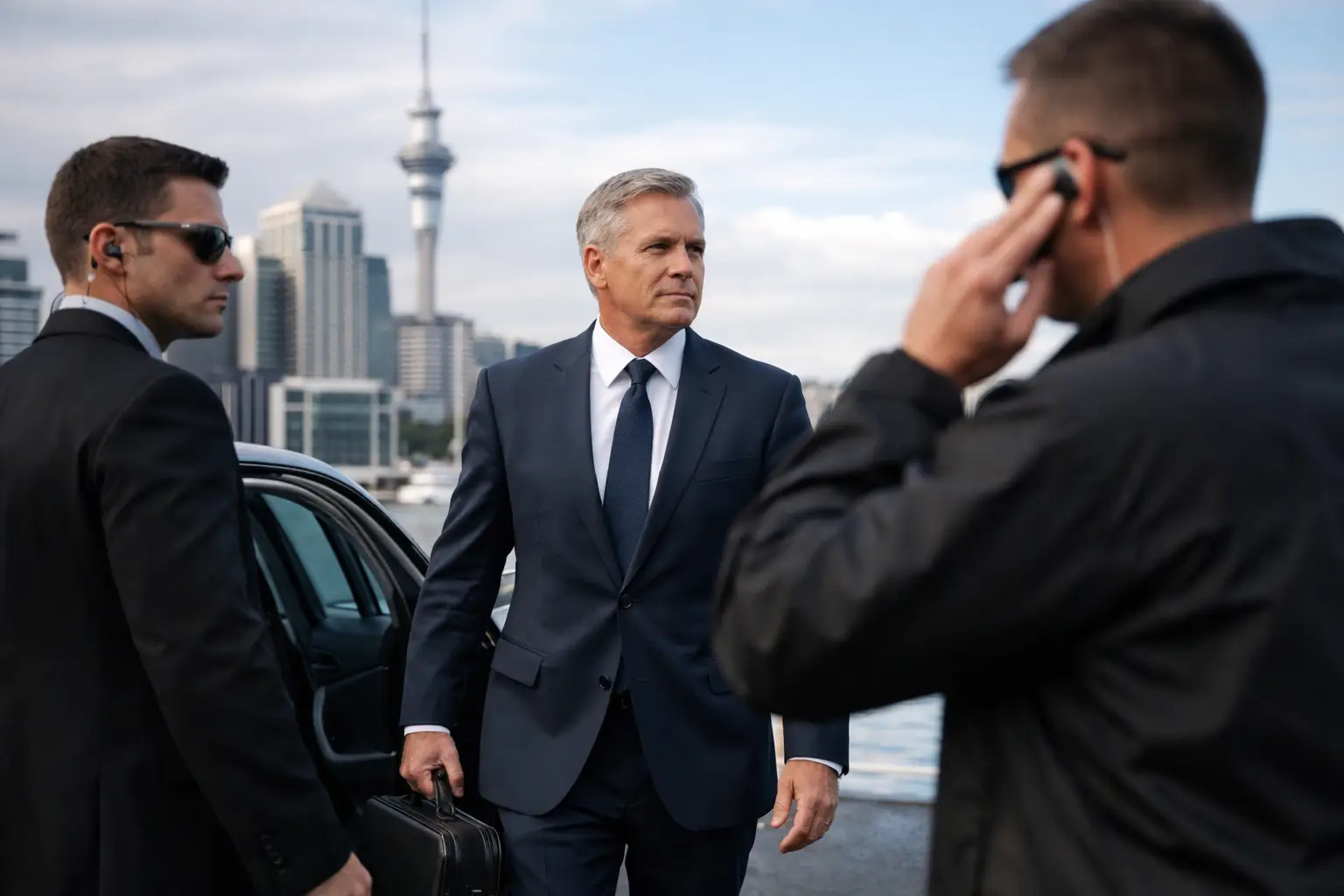
For public events, advance work matters. A security specialist should understand entrances and exits, crowd flow, safe waiting areas, the host’s security capability and the route between vehicle and venue. Protection personnel can then remain unobtrusive while retaining the ability to manage disruption decisively.
Avoid predictable routines where risk warrants it. This does not require turning an executive’s life upside down. It may simply mean varying collection points, reducing public disclosure of real-time locations and avoiding unnecessary solo travel during a period of elevated concern.
Secure the workplace, residence and public-facing events
Executive security is strongest when physical environments are designed around controlled access, good observation and clear response. At a workplace, that can include visitor management, reception procedures, access-card discipline, CCTV coverage, mail and delivery protocols, and staff training on how to report concerning behaviour.
The most effective controls are often the least dramatic. Reception staff who know how to verify an unexpected visitor, managers who escalate threats early and security personnel who communicate professionally can prevent an issue from reaching the executive’s office.
Residential protection requires greater sensitivity. A home must remain a home, particularly where partners and children are involved. Any assessment should consider perimeter visibility, access points, lighting, alarm response, privacy from the street, delivery practices and household routines. The appropriate solution may be a set of improved procedures and technology, or it may require discreet physical presence during specific periods. It depends on the assessed threat.
Events require a coordinated approach because the executive’s security is linked to the safety of guests, staff and the venue. Credential checks, crowd management, access zones and incident command arrangements should be established before doors open. A visible security presence may be appropriate at a high-profile function, while a low-profile executive protection detail may better suit a private corporate engagement.
Use trained people, not improvised protection
Executive protection is a specialist discipline. It is not adequately delivered by asking a driver, assistant or untrained staff member to act as security. They may be placed in an unsafe position and may not have the judgement, authority or experience to recognise escalating risk.
Professionally selected and licensed personnel bring situational awareness, protective planning, communication discipline and calm decision-making under pressure. Their role is not to dominate an executive’s schedule or create unnecessary attention. It is to create space, anticipate problems and resolve issues with minimum disruption.
For New Zealand organisations, verify licensing, management oversight, training standards and the provider’s ability to integrate intelligence, investigation and operational logistics. Personal protection is most effective when it can draw on a wider risk-management capability rather than operating in isolation.
TNG Security applies government-licensed, professionally managed protective services to complex executive requirements across New Zealand and beyond. The right team should be able to work quietly alongside executive assistants, corporate security managers, venues and family offices while maintaining uncompromised standards.
Prepare for incidents before they become crises
No protocol removes all risk. What distinguishes a controlled security programme is its capacity to respond when prevention is not enough.
Executives and key support staff should know how to report a threat, whom to call after hours, where to move during a workplace disruption and how communications will be managed. The plan should cover unwanted approaches, suspicious packages, online threats, protest activity, medical incidents, travel disruption and credible threats to family members. It should also identify when police, legal advisers, cyber specialists or private investigators need to be engaged.
Test the arrangements in a measured way. A short tabletop exercise can reveal whether contact numbers are current, whether decision-makers understand their authority and whether a location’s procedures will work under pressure. Exercises should build confidence, not create theatre.
After any incident or near miss, review the facts promptly. Preserve relevant evidence, document actions taken and adjust controls where required. A pattern of low-level unwanted contact may be more significant than a single isolated event, particularly when combined with digital activity or knowledge of private routines.
Security should give executives the confidence to lead, travel and represent their organisations without accepting avoidable exposure as part of the job. The most credible protection is rarely the most visible – it is the disciplined preparation that keeps a difficult situation from gaining momentum.
Latest Posts
Aug. 25, 2026
Best Security Protocols for Executives in NZ
Aug. 24, 2026
Venue Safety Requirements for New Zealand Events
Aug. 22, 2026
When Are Security Guards Required in New Zealand?

Aug. 22, 2026
Bodyguard Versus Executive Protection Services
Aug. 22, 2026